by Bat-El Lieberman, Keshet Director of Jewish Life
As May arrives, we find ourselves in the season of endings and beginnings. Schools are preparing for graduations, dance studios for recitals, recreation programs for final celebrations and families everywhere are reflecting on another year that somehow passed too quickly. Here at Keshet, we feel that same rhythm deeply. While our schools are working tirelessly to celebrate student achievements and meaningful milestones, our camp team is already preparing to launch another unforgettable summer of Keshet day and overnight camps. At the same time, new programs and new seasons are beginning to bloom—First Friends, Buddy Baseball, visits to Bonim Farms, and so many opportunities for connection, growth and belonging.
In Judaism, this moment of transition is reflected beautifully in the counting of the Omer*. For seven weeks between Passover and Shavuot, we count each day intentionally, marking not only time itself, but the journey between freedom and purpose. As I write these words, we are on the 42nd day of the Omer, six weeks and zero days, according to the traditional counting.
But that brings me to an important question: What is the “proper” way to count the Omer?
Many of us grew up with a familiar image. We recited the introductory paragraph, Hineni Muchan U’Mezuman. We said the bracha: Baruch Atah Hashem…al sefirat ha’Omer. As children, we proudly placed stickers on colorful charts or shaded another square before bedtime. For many people, the Omer feels like one of Judaism’s simplest mitzvot: straightforward, structured and universally understood.
But if you know me, you probably already know that I like to challenge assumptions.
What happens if someone cannot recite the bracha independently? What if a person does not fully understand the abstract concept of counting days toward a holiday? What if we unintentionally exclude people with disabilities because we assume there is only one “correct” way to perform a mitzvah?
At Keshet, we believe Judaism belongs to everyone.
Not symbolically. Not theoretically. Practically. Actively. Joyfully.
We believe our tradition was never meant to belong only to those who process information in a certain way, communicate verbally, memorize Hebrew text or fit into a narrow definition of participation. Judaism is inclusive at its core, and our responsibility is to continue opening doors so that every Jewish person can find meaningful ways to engage with mitzvot, community and identity.
As we approach the end of the Omer this year, I want to share two ways we counted at Keshet. Although it may look different from what many people are used to, they were both deeply authentic and deeply Jewish.
The first came from one of our high school students, who created short videos interviewing fellow students and asking them to count the Omer on camera while sharing fun Jewish facts. Was he personally reciting the Omer at that exact moment? Not necessarily. But he was doing something incredibly powerful: he was creating Jewish engagement. He was bringing Jewish ritual into conversation, friendship and community. He was helping others participate in a mitzvah and proudly carrying Jewish identity into the world around him. That, too, is sacred work. This project even got a special shoutout from Rabbi Matanky in his daily emails to Ida Crown students and families. Kol Ha’Kavod!
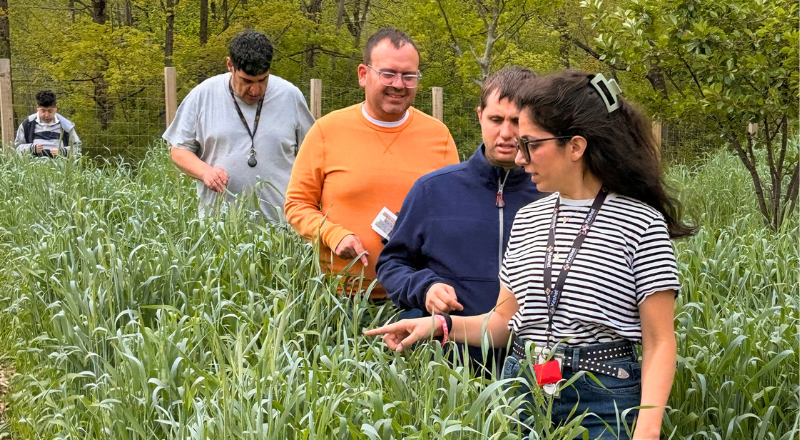
The second happened on GADOL’s first day back at The Institute of Soul & Soil. This partnership gives our team members the opportunity to learn, connect and engage with their Judaism through adamah. We started the morning the way we often do at the farm: gathered together in chevruta (partner) learning, reflecting on the meaning of the Omer and revisiting ideas many of our participants first encountered years ago as students in our high school and Sunday school programs.
Then we stepped outside.
On a beautiful spring day, surrounded by fields of different crops and rye swaying in the wind, we did something most of us have never literally done before:
We counted the Omer.
Not days on a chart. Not numbers in a siddur. Actual omers, or wheat, in the field.
Together, we walked through the rows and counted 42 omers, connecting ourselves not only to Jewish ritual, but to the agricultural roots of our tradition. Of course, we said the bracha (blessing). But we also touched the earth, felt the sunshine, smelled the growing grain and experienced Judaism with our bodies, our senses and our community.
So let me ask you:
How many of us have ever truly counted the Omer?
Today, my GADOL friends and I did.
And perhaps that is the beauty of this season, both in the Jewish calendar and in life itself. Endings create space for new beginnings. Traditions continue to grow when we allow more people to access them. And Judaism becomes stronger, richer and more meaningful when every person, of every ability, can find their own authentic way to belong within it.
*The Omer is a 49-day period between Passover and Shavuot when Jewish people count each day as a way of marking the journey from freedom to receiving the Torah. Beginning on the second night of Passover, a blessing is traditionally recited each evening as the days are counted. “Omer” literally means sheaf of grain.
